
Ontario Lowers Growth Forecast While Maintaining Infrastructure Investment

SUMMARY
Ontario’s 2026 Fall Economic Statement projects slower economic growth, higher inflation and a larger provincial deficit than anticipated in the March Budget. Despite the weaker outlook, the province is maintaining its infrastructure spending plans while introducing additional measures to support industrial investment and domestic manufacturing.
PROVINCIAL OVERVIEW
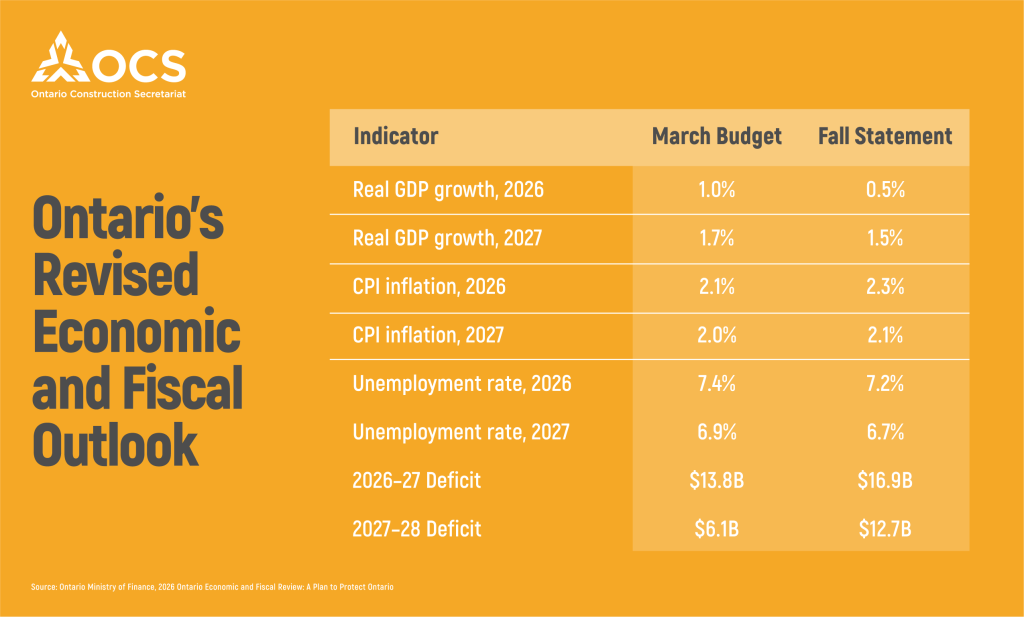
Ontario has lowered its real Gross Domestic Product (GDP) growth forecast for 2026 to 0.5%, down from 1.0% in March, amid continued trade uncertainty and U.S. tariffs. Growth is expected to improve to 1.5% in 2027, below the previous forecast of 1.7%.
The province has also revised its Consumer Price Index (CPI) inflation forecast upward to 2.3% in 2026, from 2.1% previously, before moderating to 2.1% in 2027.
Despite slower growth expectations, Ontario’s unemployment rate is now projected to average 7.2% in 2026, down from the previous forecast of 7.4%. The rate is expected to decline further to 6.7% in 2027, compared with the earlier projection of 6.9%
Meanwhile, Ontario’s projected 2026–27 deficit has increased to $16.9 billion, up $3.1 billion from March. The province expects to return to a balanced budget by 2029–30.
WHAT’S NEW FOR ONTARIO’S CONSTRUCTION SECTOR?
Despite the weaker outlook, Ontario is maintaining its approximately $211 billion infrastructure investment plan over the next decade, covering transit, highways, hospitals, schools and other infrastructure. The plan remains virtually unchanged from March.
However, the Fall Statement highlights several construction-related developments:
- Industrial investment: More than $8 billion in additional tax relief over five years is proposed through accelerated capital cost allowances, including immediate write-offs for eligible manufacturing buildings and equipment.
- Buy Ontario policies: The province is advancing domestic procurement requirements for public infrastructure projects, with further measures proposed to strengthen compliance and support local suppliers.
- Municipal infrastructure: Recent initiatives include a $1 billion federal-provincial program supporting roads, water and wastewater infrastructure in municipalities without development charges.
RECENT SUPPORT FOR INDUSTRY AND SKILLED TRADES
In addition to the measures outlined in the Fall Statement, recent federal and provincial announcements provide further updates relevant to Ontario’s construction sector.
On October 21, Canada and Ontario announced a joint $8.7 billion industrial action plan, also highlighted in the Fall Statement, to support industries affected by U.S. tariffs. The package includes approximately $5.2 billion for steel, $2.5 billion for automotive capital projects and up to $1 billion for road infrastructure supporting critical mineral development in Northern Ontario.
Separately, the federal government announced a $5,000 Red Seal Completion Bonus for eligible tradespeople who completed an apprenticeship and obtained certification on or after April 1, 2025. Applications open on November 16, 2026. The incentive aims to encourage apprenticeship completion and strengthen the skilled trades workforce.
IMPLICATIONS FOR ONTARIO’S CONSTRUCTION SECTOR
Slower growth and trade uncertainty could dampen private industrial and commercial investment. However, continued public infrastructure spending may provide stability for construction activity, while industrial tax incentives and manufacturing support could encourage new facility investments.
Overall, Ontario’s infrastructure commitments remain steady despite a weaker economic outlook, with targeted measures offering potential opportunities for industrial construction and skilled trades.
FOR MORE INFORMATION, CONTACT:
Gargi Bharti
Economic and Research Project Lead
Ontario Construction Secretariat (OCS)
180 Attwell Drive, Suite 360, Toronto, ON M9W 6A9
Phone: 416.620.5210
gbharti@iciconstruction.com
STAY CONNECTED
Your link to Ontario’s unionized ICI construction news. Sign up to our mailing list to Stay Connected.
WHY UNION?
Signatory contractors and union partners deliver skilled, safety-focused tradespeople for world-class results every time.