
Ontario’s Non-Residential Construction Prices Increase in Q4 2025

SUMMARY
Non-residential construction prices continued to rise in Ontario in the fourth quarter of 2025. Ottawa and Toronto closely matched the provincial trend, while London CMA recorded a sharp increase, the highest in the country. Industrial construction and factory projects remained key drivers of price growth. Costs remain elevated due to ongoing market pressures in labour and materials.
NON-RESIDENTIAL BUILDING CONSTRUCTION PRICE INDEX
The Building Construction Price Index (BCPI) measures changes in the prices contractors charge to construct new commercial, institutional, industrial, and residential buildings.
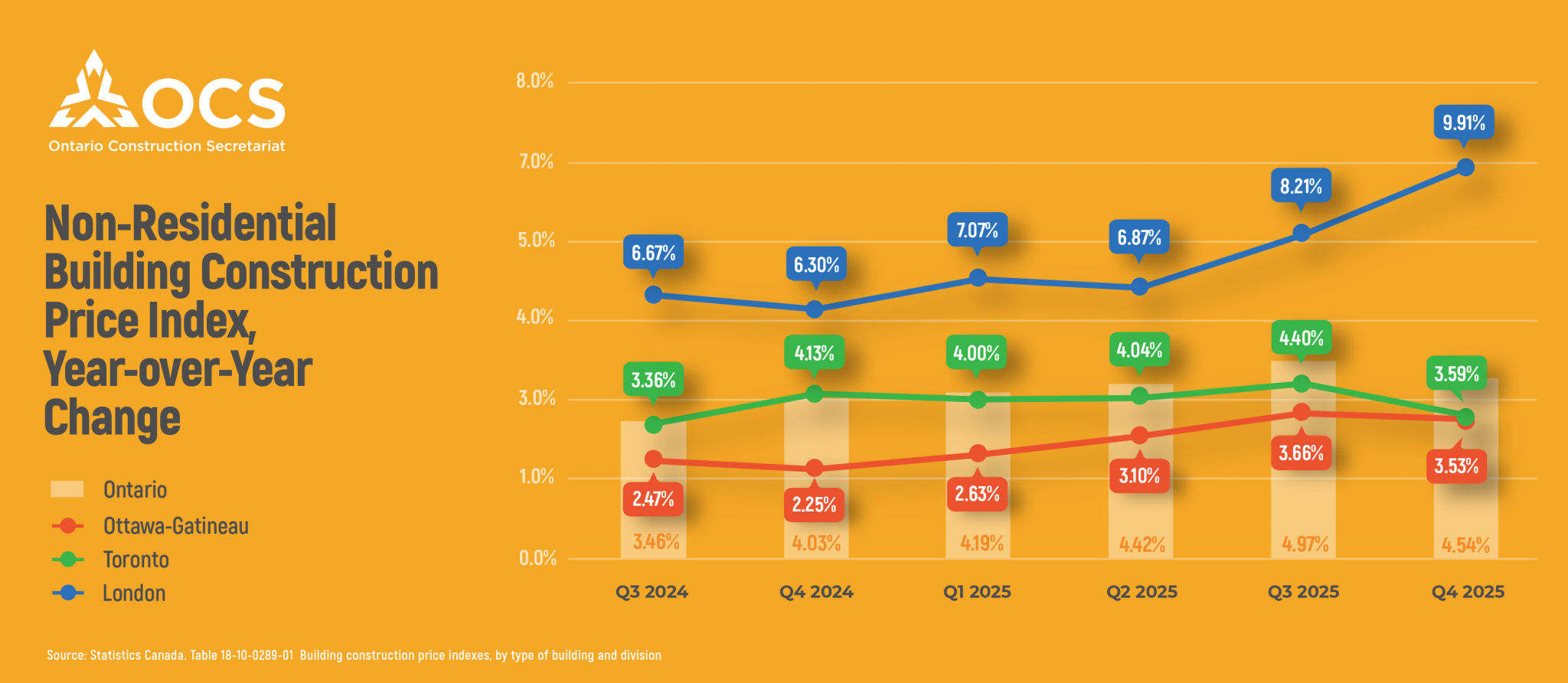
In the fourth quarter of 2025, non-residential construction prices in Ontario rose by 4.5% on a year-over-year basis. On a quarterly basis, prices increased by 0.7%.
Ottawa and Toronto moved largely in line with the provincial average, each posting growth of around 3.5%. London CMA led the trend, with prices rising by 9.9% year over year. This was the strongest increase recorded among all Canadian markets. According to Statistics Canada, prices remained elevated in part due to rising material costs.
PRICE TRENDS WITHIN THE ICI SECTOR
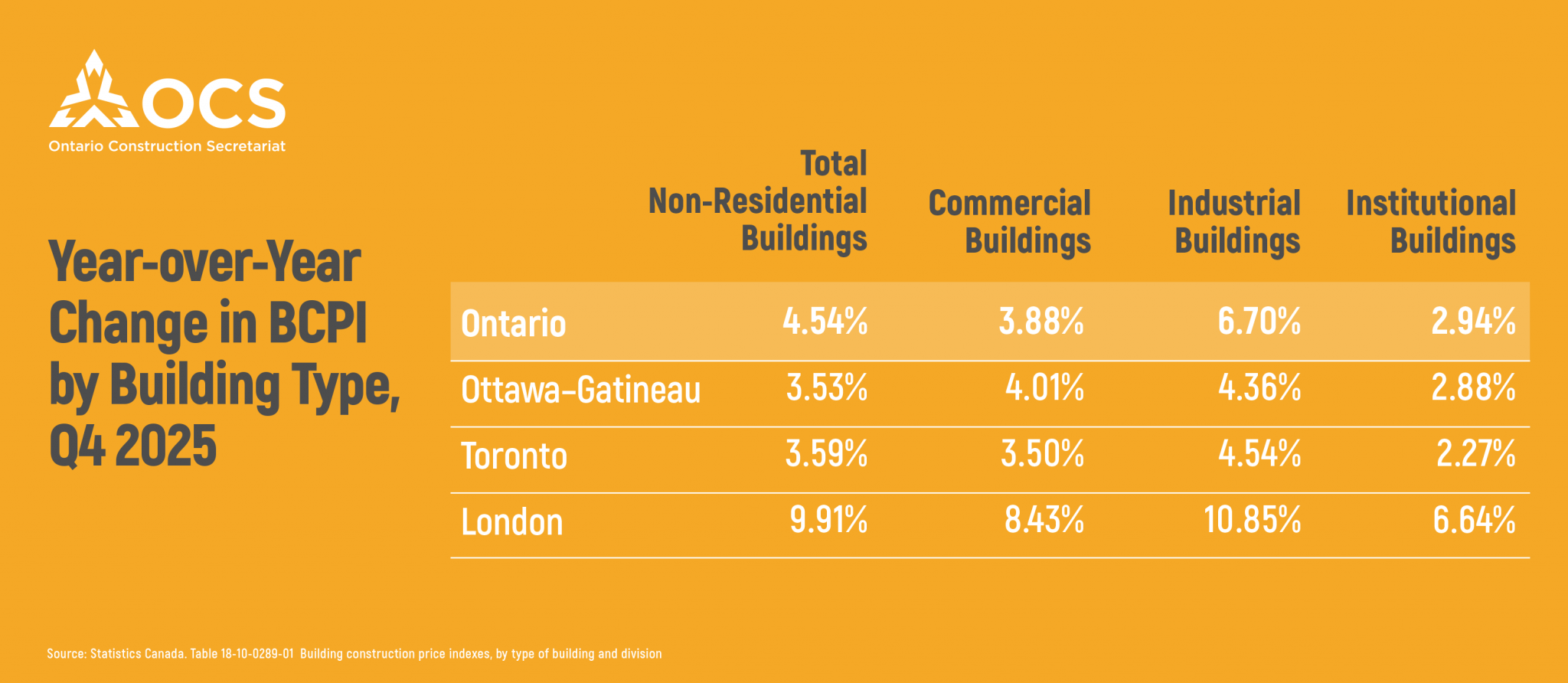
Within the non-residential sector, industrial construction recorded the highest price growth at 6.7% year over year. The increase was driven by rising costs to build factories, which climbed by 7.0%.
Commercial construction prices in Ontario increased by 3.9%, supported mainly by warehouse construction, where prices rose by 5.0%. Institutional construction posted the lowest growth rate at 2.9%.
COST CHANGES BY CONSTRUCTION DIVISION
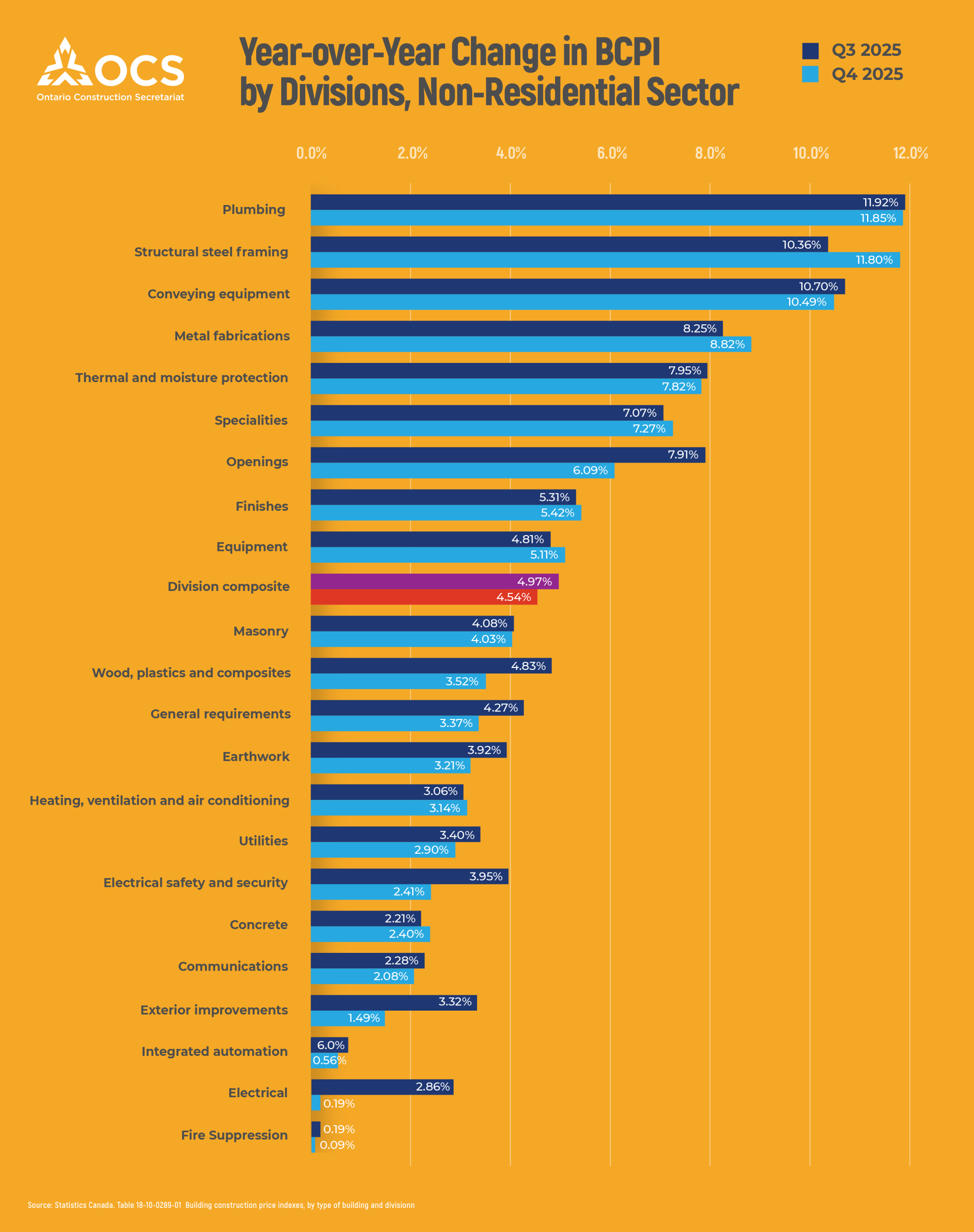
At the division level, construction costs increased across most areas. Plumbing recorded the largest year-over-year increase at 11.85% in Q4 2025. Structural steel framing followed closely at 11.80%, while conveying equipment rose by 10.49%. Metal fabrication costs also remained elevated.
Fire suppression, electrical work, and integrated automation showed little to no price growth over the year.
Compared with the previous quarter, most divisions saw prices increase. Structural steel framing posted the largest quarterly rise at 2.2%. Electrical work declined by 1.6%, while fire suppression edged down by 0.1% since Q3 2025.
FACTORS CONTRIBUTING TO ELEVATED CONSTRUCTION COSTS
Non-residential construction costs remain high due to a mix of labour, materials, and structural factors.
Desjardins notes that wages have been rising because of steady demand for workers and new collective agreements, while long-term declines in productivity have also added to costs. Demand for labour is expected to stay strong with ongoing projects and planned public infrastructure work.
The Canadian Construction Association adds that construction inflation has grown faster than consumer prices since pandemic, with steel-intensive work playing a major role. With roughly one-third of construction inputs imported, costs remain sensitive to exchange rates, tariffs, and trade policy changes, particularly for steel-related products.
FOR MORE INFORMATION, CONTACT:
Gargi Bharti
Economic and Research Project Lead
Ontario Construction Secretariat (OCS)
180 Attwell Drive, Suite 360, Toronto, ON M9W 6A9
Phone: 416.620.5210
gbharti@iciconstruction.com
STAY CONNECTED
Your link to Ontario’s unionized ICI construction news. Sign up to our mailing list to Stay Connected.
WHY UNION?
Signatory contractors and union partners deliver skilled, safety-focused tradespeople for world-class results every time.